>
Clupeiformes (Herrings) >
Dorosomatidae (Gizzard shads and sardinellas)
Etymology: Herklotsichthys: After Janus Adrian Herklots, Australian ichthyologist, 1820-1872.
Eponymy: Dr Geoffrey Alton Craig Herklots (1902–1986) was a British biologist, botanist and ornithologist at the University of Hong Kong (1928–1941). [...] (Ref. 128868), visit book page.
More on author: Rüppell.
環境:環境 / 気候帯 / 深さの範囲 / 分布範囲
生態学
海; 新鮮な水; 汽水性の 関連する礁; 深さの範囲 0 - 13 m (Ref. 82332). Tropical; 39°N - 33°S, 29°E - 166°W (Ref. 188)
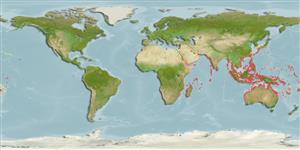
Indo-Pacific: widespread in Indian Ocean and western Pacific, including entire eastern coast of Africa, Madagascar, Mauritius eastward to Japan, eastern Australia, and Samoa (Ref. 188). Introduced into Hawaii, apparently by accident, and now abundant (Ref. 188). At least one country reports adverse ecological impact after introduction.
初回成熟時の長さ / サイズ / 重さ / 年齢
成熟: Lm 12.3, range 7 - 17 cm
Max length : 25.0 cm SL オス/雌雄の選別がない; (Ref. 48635); common length : 10.0 cm SL オス/雌雄の選別がない; (Ref. 188)
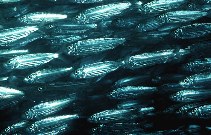
背面の脊椎 (合計) : 0; 背鰭 (合計) : 16 - 23; 肛門の骨: 0; 臀鰭: 15 - 21. Diagnosis: Body slender, its depth 18 to 30% of standard length; presence of two fleshy outgrowths on the hind margin of the gill opening; sharp belly with keeled scutes, 16-19 pre-pelvic and 12-14 post-pelvic scutes (Ref. 188, 3259). The presence of elongate wing-like scales underneath the normal paired pre-dorsal scales separate it from all other species except the two Australian species with prominent black spots on the flank, Herklotsichthys koningsbergeri and Herklotsichthys Species A, and the unspotted Herklotsichthys Species B, which has dusky tips to dorsal and caudal fins and more lower gill rakers, 36-42 vs. 33-36 in H. quadrimaculatus (Ref. 188). Flank silvery with an electric blue line preceded by two orange spots (Ref. 188).
Body shape (shape guide): fusiform / normal; Cross section: oval.
Adults form schools near mangroves, shallow coastal bays and lagoons during the day and moves further offshore into deeper water by night (Ref. 188, 48635); at depths of 0-13m (Ref. 58302, 82332). Known in mills around in large schools under wharves or along sandy beaches in protected bays (Ref. 26367). Pelagic (Ref. 58302). Adults feed on zooplankton, mainly at night, chiefly copepods in juvenile stages, but larger prey as adults (chaetognaths, polychaetes, shrimps and small fishes) (Ref. 188). Breeding takes place during the first year and probably survives only a few months after maturity (Ref. 188). Migratory behaviour is undetermined (Ref. 126106). Marketed fresh and dried salted (Ref. 188). Usually parceled in leaves and baked in a motu oven. Do not recover quite as quickly as other species of baitfish after heavy fishing (Ref. 26367).
ライフサイクルと交尾行動
成熟 | 繁殖 | 放精 | 卵 | 生産力 | 幼生
Oviparous (Ref. 205). Breeds during its first year and probably survives only a few months after maturity (Ref. 188).
Whitehead, P.J.P., 1985. FAO Species Catalogue. Vol. 7. Clupeoid fishes of the world (suborder Clupeoidei). An annotated and illustrated catalogue of the herrings, sardines, pilchards, sprats, shads, anchovies and wolf-herrings. FAO Fish. Synop. 125(7/1):1-303. Rome: FAO. (Ref. 188)
IUCNのレッドリストの状況は (Ref. 130435: Version 2025-2 (Global))
人間に対する脅威
Potential pest (Ref. 6362)
人間の用途
水産業: 少数商業の; 餌: usually
用具
特記事項
XMLをダウンロードして下さい
インターネットの情報源
モデルに基づく推定値
好ましい温度 (参照
123201): 24.9 - 29.3, mean 28.5 °C (based on 3173 cells).
系統多様性指数 (参照
82804): PD
50 = 0.5002 [Uniqueness, from 0.5 = low to 2.0 = high].
Bayesian length-weight: a=0.00933 (0.00571 - 0.01526), b=3.10 (2.96 - 3.24), in cm total length, based on LWR estimates for this species & (Sub)family-body (Ref.
93245).
栄養段階 (参照
69278): 3.6 ±0.4 se; based on diet studies.
Generation time: 1.1 ( na - na) years. Estimated as median ln(3)/K based on 1
growth studies.
回復力 (参照
120179): 高い, 15か月以下の倍増期間の最小個体群 (K=2.6).
漁業の脆弱性 (Ref.
59153): Low vulnerability (17 of 100).
🛈
気候脆弱性 (Ref.
125649): High vulnerability (58 of 100).
🛈
栄養素 (Ref.
124155): Calcium = 121 [63, 259] mg/100g; Iron = 1.42 [0.68, 2.55] mg/100g; Protein = 19.8 [18.5, 21.1] %; Omega3 = 0.215 [0.106, 0.453] g/100g; Selenium = 40.7 [18.6, 93.2] μg/100g; VitaminA = 42.4 [13.2, 139.7] μg/100g; Zinc = 1.82 [1.16, 2.83] mg/100g (wet weight);