>
Clupeiformes (Herrings) >
Dorosomatidae (Gizzard shads and sardinellas)
Etymology: Herklotsichthys: After Janus Adrian Herklots, Australian ichthyologist, 1820-1872.
Eponymy: Dr Geoffrey Alton Craig Herklots (1902–1986) was a British biologist, botanist and ornithologist at the University of Hong Kong (1928–1941). [...] (Ref. 128868), visit book page.
More on author: Rüppell.
Môi trường: môi trường / vùng khí hậu / Mức độ sâu / phạm vi phân phối
Sinh thái học
biển; nước ngọt; thuộc về nước lợ cùng sống ở rạn san hô; mức độ sâu 0 - 13 m (Ref. 82332). Tropical; 39°N - 33°S, 29°E - 166°W (Ref. 188)
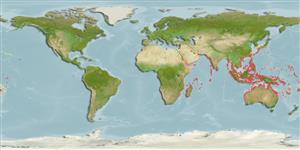
Indo-Pacific: widespread in Indian Ocean and western Pacific, including entire eastern coast of Africa, Madagascar, Mauritius eastward to Japan, eastern Australia, and Samoa (Ref. 188). Introduced into Hawaii, apparently by accident, and now abundant (Ref. 188). At least one country reports adverse ecological impact after introduction.
Chiều dài lúc trưởng thành đầu tiên / Bộ gần gũi / Khối lượng (Trọng lượng) / Tuổi
Chín muồi sinh dục: Lm 12.3, range 7 - 17 cm
Max length : 25.0 cm SL con đực/không giới tính; (Ref. 48635); common length : 10.0 cm SL con đực/không giới tính; (Ref. 188)
Các tia vây lưng cứng (tổng cộng) : 0; Các vây lưng mềm (tổng cộng) : 16 - 23; Tia cứng vây hậu môn: 0; Tia mềm vây hậu môn: 15 - 21. Diagnosis: Body slender, its depth 18 to 30% of standard length; presence of two fleshy outgrowths on the hind margin of the gill opening; sharp belly with keeled scutes, 16-19 pre-pelvic and 12-14 post-pelvic scutes (Ref. 188, 3259). The presence of elongate wing-like scales underneath the normal paired pre-dorsal scales separate it from all other species except the two Australian species with prominent black spots on the flank, Herklotsichthys koningsbergeri and Herklotsichthys Species A, and the unspotted Herklotsichthys Species B, which has dusky tips to dorsal and caudal fins and more lower gill rakers, 36-42 vs. 33-36 in H. quadrimaculatus (Ref. 188). Flank silvery with an electric blue line preceded by two orange spots (Ref. 188).
Body shape (shape guide): fusiform / normal; Cross section: oval.
Adults form schools near mangroves, shallow coastal bays and lagoons during the day and moves further offshore into deeper water by night (Ref. 188, 48635); at depths of 0-13m (Ref. 58302, 82332). Known in mills around in large schools under wharves or along sandy beaches in protected bays (Ref. 26367). Pelagic (Ref. 58302). Adults feed on zooplankton, mainly at night, chiefly copepods in juvenile stages, but larger prey as adults (chaetognaths, polychaetes, shrimps and small fishes) (Ref. 188). Breeding takes place during the first year and probably survives only a few months after maturity (Ref. 188). Migratory behaviour is undetermined (Ref. 126106). Marketed fresh and dried salted (Ref. 188). Usually parceled in leaves and baked in a motu oven. Do not recover quite as quickly as other species of baitfish after heavy fishing (Ref. 26367).
Oviparous (Ref. 205). Breeds during its first year and probably survives only a few months after maturity (Ref. 188).
Whitehead, P.J.P., 1985. FAO Species Catalogue. Vol. 7. Clupeoid fishes of the world (suborder Clupeoidei). An annotated and illustrated catalogue of the herrings, sardines, pilchards, sprats, shads, anchovies and wolf-herrings. FAO Fish. Synop. 125(7/1):1-303. Rome: FAO. (Ref. 188)
Tình trạng Sách đỏ IUCN (Ref. 130435: Version 2025-2 (Global))
Mối đe dọa đối với con người
Potential pest (Ref. 6362)
Sử dụng của con người
Các nghề cá: buôn bán nhỏ; mồi: usually
Các công cụ
Báo cáo đặc biệt
Tải xuống XML
Các nguồn internet
Ước tính dựa trên mô hình
Nhiệt độ ưa thích (Tài liệu tham khảo
123201): 24.9 - 29.3, mean 28.5 °C (based on 3173 cells).
Chỉ số đa dạng phát sinh loài (Tài liệu tham khảo
82804): PD
50 = 0.5002 [Uniqueness, from 0.5 = low to 2.0 = high].
Bayesian length-weight: a=0.00933 (0.00571 - 0.01526), b=3.10 (2.96 - 3.24), in cm total length, based on LWR estimates for this species & (Sub)family-body (Ref.
93245).
Mức dinh dưỡng (Tài liệu tham khảo
69278): 3.6 ±0.4 se; based on diet studies.
Generation time: 1.1 ( na - na) years. Estimated as median ln(3)/K based on 1
growth studies.
Thích nghi nhanh (Tài liệu tham khảo
120179): Chiêù cao, thời gian nhân đôi của chủng quần tối thiểu là dưới 15 tháng (K=2.6).
Sự dễ bị tổn thương của nghề đánh cá (Ref.
59153): Low vulnerability (17 of 100).
🛈
Sự dễ bị tổn thương của khí hậu (Ref.
125649): High vulnerability (58 of 100).
🛈
Chất dinh dưỡng (Ref.
124155): Calcium = 121 [63, 259] mg/100g; Iron = 1.42 [0.68, 2.55] mg/100g; Protein = 19.8 [18.5, 21.1] %; Omega3 = 0.215 [0.106, 0.453] g/100g; Selenium = 40.7 [18.6, 93.2] μg/100g; VitaminA = 42.4 [13.2, 139.7] μg/100g; Zinc = 1.82 [1.16, 2.83] mg/100g (wet weight);